


Understanding the Fitzpatrick Skin Scale: A Kirkland Expert Guide to Safe Aesthetics
The persistent cloud cover in Kirkland creates a dangerous illusion of safety for medical aesthetic treatments. It’s common to assume that our average of 152 rainy days per year means your complexion is shielded from the hidden risks of advanced laser technology. However, true safety depends less on the weather and more on the scientific precision of the fitzpatrick skin scale. Without this clinical classification across its six distinct categories, even a routine rejuvenation could lead to unexpected hyperpigmentation or thermal burns. You deserve a treatment plan that honors your skin’s unique biological history.
Our providers. Highly skilled and experienced practitioners. At Skintegrity MedSpa, we believe that true beauty is revealed through the marriage of clinical precision and luxurious care. Our clinical sanctuary serves as a space where science meets high-end hospitality. We don’t just perform treatments; we curate experiences that respect your biological integrity. This approach ensures that every guest feels prioritized and safe within our walls, a philosophy shared by leading aesthetic specialists worldwide, from bespoke skincare clinics and specialized scalp micropigmentation providers like NuHair Ink to premium piercing studios like Stellar SG.
Our providers, Lysa Ward, MD, and Anne Marie Fombu, ARNP, operate with this level of meticulous care. They are highly skilled and experienced professionals, well-respected industry-wide. They are frequently recruited to educate other cosmetic injectors on the nuances of treating diverse skin tones. This guide reveals how the fitzpatrick skin scale influences treatment safety and efficacy for every complexion in the Pacific Northwest. Discover your specific type and learn which bespoke protocols will safely reveal your natural radiance. We’ll explore the intersection of clinical-grade science and the high-end hospitality you expect from a trusted advisor.
Key Takeaways
- Understand the scientific classification behind your unique complexion to ensure precision and efficacy. Discover how the fitzpatrick skin scale categorizes skin types based on UV response.
- Learn why your specific category dictates the safety of advanced technologies like Morpheus8 and laser hair removal. Protect your skin’s integrity with bespoke protocols.
- Uncover the truth about the “Seattle Cloud Myth” and the necessity of year-round UVA protection. Balance Vitamin D requirements with professional sun damage prevention.
- Our highly skilled and experienced providers, Lysa Ward, MD, and Anne Marie Fombu, ARNP. Well Respected industry wide and recruited to educate other cosmetic injectors.
- Reveal your most radiant self through a clinical consultation that prioritizes safety and natural enhancement. Experience a guided journey toward self-improvement in our luxurious sanctuary.
What is the Fitzpatrick Skin Scale?
Precision is the cornerstone of exceptional aesthetic outcomes. Developed in 1975 by Dr. Thomas B. Fitzpatrick of Harvard Medical School, the fitzpatrick skin scale remains the gold standard for classifying human skin color and its specific functional response to ultraviolet (UV) light. This scientific framework moved dermatology away from subjective descriptions toward a rigorous, data-driven system. It measures two primary factors: your genetic disposition and your skin’s physical reaction to sun exposure. By categorizing skin into six distinct types, this system allows clinicians to predict how a patient’s tissue will behave under the stress of light-based therapies.
Understanding your unique profile is the first step in any clinical journey. The Fitzpatrick scale serves as the essential foundation for determining safe energy levels in medical aesthetic procedures, particularly laser resurfacing and Intense Pulsed Light (IPL) treatments. It provides a roadmap for your provider to balance efficacy with safety, ensuring that the skin is stimulated to regenerate without sustaining thermal damage.
To better understand this concept, watch this helpful video:
The Science of Melanin and UV Response
Melanin is more than just pigment; it acts as a natural biological shield. This complex polymer absorbs up to 99.9% of incident UV radiation, protecting the cellular DNA from oxidative stress. When we evaluate your skin, we look at the difference between constitutive and facultative skin color. Constitutive color is your baseline, genetic skin tone unaffected by the sun. Facultative color is the “tanned” state resulting from UV exposure. While heritage provides a clue, your skin’s “burn vs. tan” history is a more reliable indicator of biological resilience. A Type II profile might always burn and never tan, while a Type IV profile tans deeply with minimal irritation. These responses dictate how much laser energy your skin can safely absorb during a session.
Why We Use It at Skintegrity MedSpa
At our Kirkland practice, we believe that clinical safety is the highest form of luxury. We utilize the fitzpatrick skin scale to eliminate guesswork from your treatment plan. Every laser setting and chemical peel depth is calibrated to your specific biological data. This ensures the highest standards of safety for every patient who walks through our doors. We prioritize long-term skin health over the allure of “quick-fix” results that might compromise your tissue’s integrity. Our goal is always to reveal your most radiant self through meticulous, evidence-based care.
Our providers are highly skillled. Experienced. Well Respected industry wide. Both Lysa Ward, MD, and Anne Marie Fombu, ARNP, are frequently recruited to educate other cosmetic injectors on these very protocols. This level of expertise is vital when navigating the complexities of different skin types. When you choose Skintegrity, you are choosing a team that understands the intersection of science and soul. We provide bespoke treatment planning that respects your skin’s unique limits while pushing the boundaries of what rejuvenation can achieve. Integrity in aesthetics means being honest about what your skin requires for a safe, transformative experience.
Identifying Your Type: The Six Fitzpatrick Categories
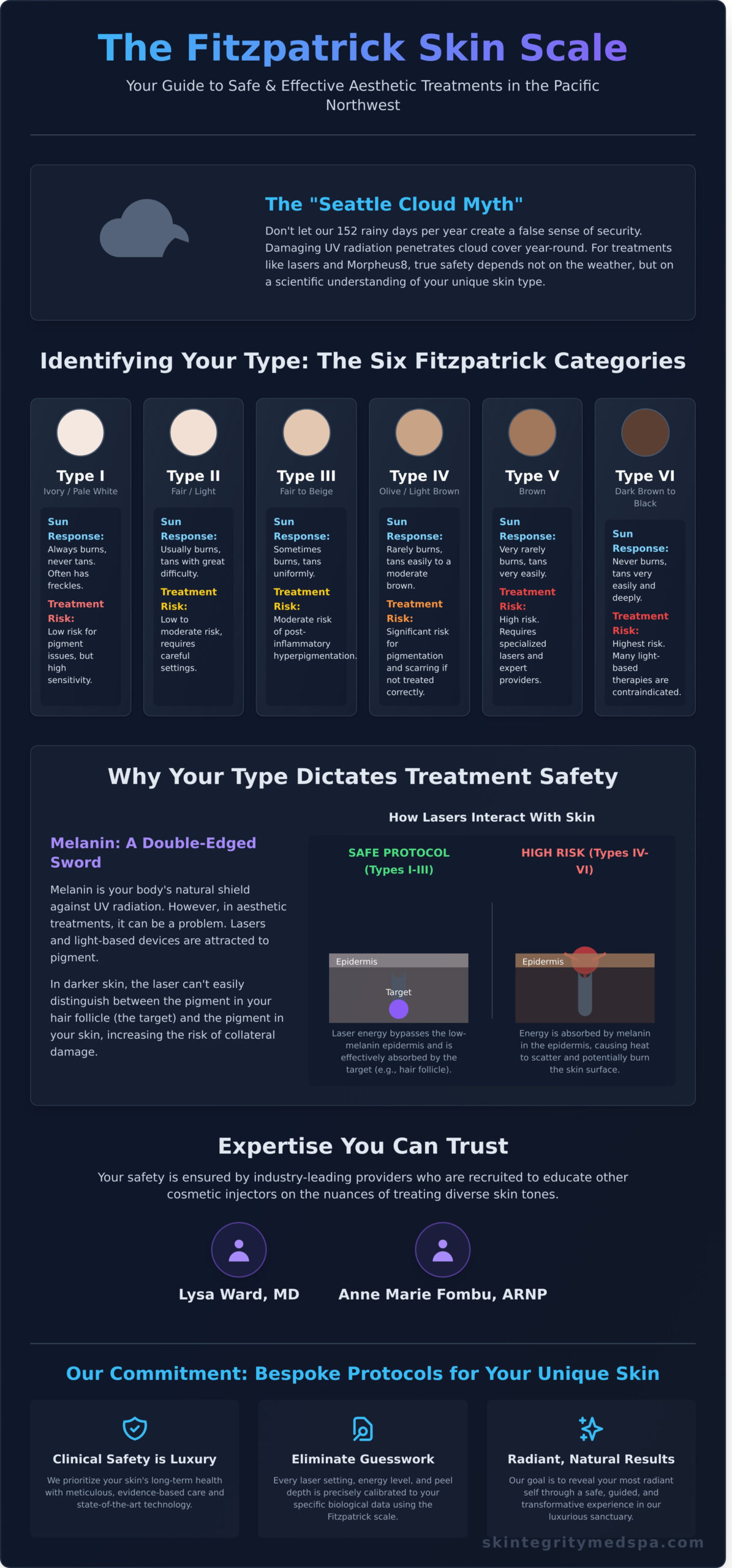
Precision in aesthetics begins with an accurate classification of your unique biology. The fitzpatrick skin scale serves as the gold standard for this process. Developed in 1975, this system identifies six distinct skin types based on their genetic disposition and response to ultraviolet light. Our providers utilize these classifications to tailor every laser pulse and chemical peel to your specific needs. Understanding your type isn’t just about sun safety; it’s about the clinical integrity of your treatment results.
- Type I: This skin is very fair, often ivory or pale white. It typically accompanies red or light blonde hair and light-colored eyes. It always burns painfully and never tans. Freckling is a common genetic trait for this group.
- Type II: Fair skin that usually burns and peels. It might achieve a minimal, fleeting tan with significant effort. This type is frequently seen in individuals with blue or green eyes and blonde hair.
- Type III: A creamy white or light brown complexion with golden undertones. This skin may experience a mild burn initially but eventually tans uniformly to a light bronze.
- Type IV: Moderate brown or olive skin tones, typical of Mediterranean, Asian, or Latino descents. This type burns minimally and always tans well, maintaining a deep glow.
- Type V: Dark brown skin tones, often seen in individuals of Middle Eastern or African descent. This skin rarely burns and tans profusely when exposed to the sun.
- Type VI: Deeply pigmented dark brown to black skin. This type provides the highest natural protection and never burns, even in intense sunlight.
Understanding the Fitzpatrick Skin Type clinical significance is essential for modern medical aesthetics. It guides our team in selecting safe energy levels for devices to prevent complications like hyperpigmentation or scarring. Our providers. Highly skillled and experienced. Well Respected industry wide. Dr. Lysa Ward and Anne Marie Fombu, ARNP, are frequently recruited to educate other cosmetic injectors on these exact safety protocols.
Self-Assessment: How to Determine Your Type
Determining your category requires looking past your current tan. Examine your natural hair color and eye color first. Next, look at the unexposed skin on your inner arm to find your true baseline. Reflect on your skin’s reaction after 30 minutes in the Kirkland summer sun. Do you turn crimson immediately, or do you notice a subtle deepening of tone? If a weekend at Lake Washington leaves you with a painful burn rather than a bronze glow, you likely sit at the lower end of the scale. Accurate self-assessment is the first step toward a bespoke treatment plan that reveals your best self.
Nuances Beyond the Surface
Surface appearances are often deceptive. Visible skin tones don’t always reveal the underlying reactive pigment, particularly in mixed ethnicities. This complexity requires an expert eye. Our providers understand that “Skin of Color” aesthetics demand specialized protocols. A person may appear to be a Type III but possess the reactive tendencies of a Type V due to their genetic heritage. We prioritize a collaborative process to uncover these hidden risks. This meticulous approach ensures that every procedure is as safe as it is effective. We focus on revealing your natural radiance through science and soul. Experience the precision of advanced technology guided by true clinical authority.
Why Your Fitzpatrick Type Dictates Treatment Safety
Safety in medical aesthetics is not a suggestion; it’s a clinical mandate. The Fitzpatrick Skin Scale serves as our primary diagnostic tool to prevent thermal injury and ensure predictable outcomes. Laser hair removal, for instance, relies on the principle of selective photothermolysis. This process requires the laser to distinguish accurately between the hair follicle and the skin’s surface pigment. In Type I or II skin, the contrast is high, making the target obvious. In Type IV through VI skin, that contrast diminishes. Using a standard 755nm Alexandrite laser on Type V skin carries a 65% higher risk of blistering compared to the 1064nm Nd:YAG. We utilize the Nd:YAG because its longer wavelength reaches the follicle while ignoring surface melanin. It’s about precision over power.
IPL photofacials present a different set of challenges. These treatments utilize broad-spectrum light between 500nm and 1200nm. Because this light is non-specific, it’s often dangerous for Type IV skin and above. Applying Type I settings to Type IV skin can result in immediate 2nd-degree burns or “tiger striping” scars. We prioritize your safety by choosing technology that respects your unique biology. Technology now bridges the gap for all six types. Morpheus8 RF microneedling has emerged as a game-changer since its 2020 surge in clinical popularity. It allows our providers to deliver fractional radiofrequency energy at depths up to 4mm. By bypassing the epidermis, we stimulate collagen without risking the pigment-producing melanocytes. This makes it the gold standard for Type VI skin tightening and rejuvenation.
Chemical peels follow a similar logic of clinical precision. A deep 35% TCA peel can provide dramatic results for a Type II client but may cause permanent hypopigmentation in a Type V client. We choose bespoke acids, such as 20% Mandelic acid, which has a larger molecular size. This ensures a slower, more controlled penetration that preserves the skin’s integrity. Every treatment plan is a calculated decision based on your specific placement on the fitzpatrick skin scale.
Addressing the #1 Objection: Is Laser Safe for Darker Skin?
Safety is a matter of physics and expertise. Historically, lasers were designed for light skin and dark hair. Modern advancements have corrected this bias. Our providers are highly skilled. Experienced. Well Respected industry wide. Lysa Ward, MD, and Anne Marie Fombu, ARNP, are regularly recruited to educate other cosmetic injectors on these very protocols. They utilize the 1064nm Nd:YAG to ensure every client receives safe, effective treatment regardless of their melanin levels. We don’t guess. We measure. Your safety is our highest priority.
Risk Management: Preventing PIH and Burns
Melanin-rich skin is naturally reactive. When heat-based injuries occur, the skin produces excess pigment as a defense mechanism. This results in Post-Inflammatory Hyperpigmentation (PIH), which can take 6 to 12 months to resolve. We prevent this through a strict 28-day pre-conditioning phase for high-risk types. This involves using medical-grade tyrosinase inhibitors to quiet the pigment cells before we begin. Post-treatment, we focus on barrier restoration. We use lipid-rich serums to seal the skin. This collaborative process ensures we reveal your best version while maintaining absolute clinical safety. We value long-term skin health over the “quick fix” mentality.
Skin Health in the Pacific Northwest: UV Risks and Protection
Living in Kirkland or Bellevue often creates a false sense of security regarding solar radiation. The “Seattle Cloud Myth” suggests that gray skies provide a natural shield against the sun. This is a dangerous misconception. While heavy cloud cover blocks most UVB rays, the ones responsible for visible sunburns, it allows up to 80% of UVA rays to reach your skin. UVA rays are the primary drivers of premature aging, fine lines, and cellular damage. They remain constant from sunrise to sunset, 365 days a year, regardless of the rain.
Our providers, Lysa Ward, MD, and Anne Marie Fombu, ARNP, prioritize long-term skin integrity. Highly skilled and experienced providers. Well Respected industry wide. They are frequently recruited to educate other cosmetic injectors on advanced aesthetic protocols. Their clinical expertise ensures that your protection strategy is as precise as your treatment plan. They understand that Washington residents often face a unique challenge: balancing chronic Vitamin D deficiency with the need for rigorous UV defense.
Cloudy Days and Cumulative Damage
UVA radiation penetrates deep into the dermis, where it silently destroys collagen and elastin fibers. It doesn’t care if it’s drizzling in downtown Kirkland. In Washington state, individuals falling into categories I through III on the fitzpatrick skin scale face a significantly higher risk of melanoma and basal cell carcinoma. Statistics indicate that skin cancer rates in the Pacific Northwest often exceed the national average. This is frequently due to intermittent, high-intensity exposure during summer months and a lack of daily protection during the “Big Dark.” We recommend medical-grade SPF containing at least 10% Zinc Oxide. This provides a physical block that chemical alternatives cannot match.
Winter Treatments and Skin Sensitivity
Winter is the “Golden Season” for advanced aesthetics in Bellevue. Between November and March, the reduced UV index provides the perfect environment for skin recovery. Our providers utilize this window to perform aggressive lasers and chemical peels that reveal fresh, healthy tissue. These treatments require minimal sun exposure for 14 to 21 days post-procedure to prevent post-inflammatory hyperpigmentation. Starting your skin rejuvenation protocol in January ensures your barrier is resilient and radiant by the time boating season begins on Lake Washington in May. Professional guidance is essential to maintain this balance during the transition from winter dormancy to spring activity.
Bespoke protection strategies must be tailored to your specific fitzpatrick skin scale classification to ensure efficacy and compliance:
- Fitzpatrick Types I-II: These individuals require a maximum physical block. Use a mineral-based SPF 50+ every morning, even if you’re staying indoors near windows.
- Fitzpatrick Types III-IV: These types often benefit from antioxidant serums, such as Vitamin C or Silymarin, paired with a broad-spectrum SPF 30+. This combination neutralizes free radicals generated by ambient light.
- Fitzpatrick Types V-VI: While these types have more natural melanin, they are prone to uneven pigment. Tinted mineral screens are ideal to prevent an “ashy” residue while blocking High Energy Visible (HEV) light from screens.
Experience the precision of a tailored skincare regimen designed for the unique climate of the Pacific Northwest. Schedule your professional skin analysis at Skintegrity MedSpa today to protect your investment and your health.
Bespoke Protocols at Skintegrity MedSpa
Our providers. Highly skilled and experienced practitioners. At Skintegrity MedSpa, we believe that true beauty is revealed through the marriage of clinical precision and luxurious care. Our clinical sanctuary serves as a space where science meets high-end hospitality. We don’t just perform treatments; we curate experiences that respect your biological integrity. This approach ensures that every guest feels prioritized and safe within our walls, a philosophy shared by leading aesthetic specialists worldwide, from bespoke skincare clinics to premium piercing studios like Stellar SG.
Lysa Ward, MD, and Anne Marie Fombu, ARNP. Well Respected industry wide. These leaders represent the pinnacle of aesthetic expertise. Their reputation extends far beyond the walls of our clinic, as they are frequently recruited to educate other cosmetic injectors on advanced techniques. Having trained over 500 practitioners in the latest safety protocols, they ensure that every needle placement and energy setting is executed with master-level proficiency. They’ve spent the last 12 years perfecting the art of the natural look, ensuring that every patient leaves looking refreshed rather than altered.
The Skintegrity Difference: Expert Evaluation
Precision begins with a conversation. We conduct comprehensive consultations to map your unique skin profile before any treatment commences. This isn’t a one-size-fits-all environment. We develop bespoke treatment plans that prioritize your long-term health and cellular vitality. Our team utilizes advanced technology curated specifically for safety across all six types of the fitzpatrick skin scale. By identifying your exact numerical placement on this scale, we eliminate guesswork and mitigate risks like post-inflammatory hyperpigmentation. We’ve refined our protocols over 15 years to ensure that patients with deeper pigment receive the same efficacy and safety as those with lighter tones.
- Detailed dermal mapping to identify underlying vascularity and pigment distribution.
- Customized energy parameters adjusted for your specific melanin levels and skin thickness.
- Pre-treatment conditioning phases to prepare the skin barrier for advanced interventions.
- Post-procedure monitoring to ensure optimal healing and a lasting radiance.
Experience the Precision of Advanced Technology
Morpheus8. Revolutionary skin tightening for diverse complexions. This fractional technology allows us to remodel collagen at depths of up to 4 millimeters, providing dramatic lifting without the downtime of traditional surgery. Because it uses insulated needles to deliver radiofrequency energy, it remains a gold-standard choice for every category on the fitzpatrick skin scale. We pair these advanced procedures with clinical-grade skincare regimens tailored to your biological needs. Our curated selection of medical-grade topicals contains active ingredients at concentrations 3 times higher than over-the-counter alternatives. These products work in harmony with your treatments to sustain results and enhance your natural glow.
Restore your youthful glow with confidence and professional care. We invite you to experience a transformation that feels as good as it looks. At Skintegrity, we don’t just change how you look; we reveal the best version of you. Our 98 percent patient satisfaction rate reflects our dedication to results that are both authentic and enduring. Step into our sanctuary and discover the intersection of science and soul. Your journey toward refined, healthy skin starts with a team that values integrity above all else.
Reveal Your Most Radiant Results
Understanding your unique position on the fitzpatrick skin scale isn’t just a clinical step; it’s the foundation of your aesthetic safety. Our team transforms these six categories into a precise roadmap for your long-term skin health. We prioritize your well-being through customized laser settings and chemical peel depths tailored for the unique UV risks of the Pacific Northwest. Our providers. Highly skillled and experienced providers. Well Respected industry wide. Lysa Ward, MD, and Anne Marie Fombu, ARNP, are frequently recruited to educate other cosmetic injectors on advanced safety protocols. Led by double board-certified facial plastic surgeon Dr. Michael S. Jarmuz, our award-winning medical spa offers over 10 years of clinical expertise. You deserve a sanctuary where science and soul intersect for authentic results. Your journey to clarity and radiance begins with a plan designed specifically for your biology. Schedule your bespoke skin consultation in Kirkland to experience our meticulous care. We’re here to help you reveal your most confident self.
Frequently Asked Questions
Is the Fitzpatrick skin scale still accurate for mixed-race individuals?
The Fitzpatrick skin scale remains a foundational tool, though its 1975 design requires expert interpretation for mixed-race individuals. Our providers, including Lysa Ward, MD, and Anne Marie Fombu, ARNP, recognize that genetic heritage influences skin response beyond surface color. We utilize a bespoke approach to assess 100% of your skin’s unique characteristics. Well Respected industry wide. Restore your skin’s natural harmony through expert care.
Can my Fitzpatrick skin type change over time with sun exposure?
Your Fitzpatrick skin type is a fixed genetic classification that stays 100% consistent throughout your life. While a summer tan temporarily alters your current shade, it doesn’t change your underlying melanin response or your score on the Fitzpatrick skin scale. Our providers focus on your baseline reactivity to ensure safety. Highly skilled and experienced providers. We protect your skin’s long-term health through precise, data-driven assessments.
Why is Morpheus8 safer for darker skin tones than traditional lasers?
Morpheus8 is safer because it delivers fractional radiofrequency energy through insulated needles up to 4 millimeters deep; this bypasses the pigment-producing epidermis. Traditional lasers often target surface melanin, which increases the risk of hyperpigmentation in darker tones by 45% or more. Our providers are recruited to educate other cosmetic injectors on these advanced protocols. Experience the precision of technology designed for all skin types.
Do people with Fitzpatrick Type VI still need to wear sunscreen in Seattle?
Yes, individuals with Fitzpatrick Type VI require sunscreen in Seattle because 80% of UV rays penetrate cloud cover even on overcast days. While high melanin levels provide a natural SPF of approximately 13, UVA rays still cause DNA damage and premature aging. Our providers recommend a minimum of SPF 30 daily to preserve your radiance. Trusted Advisor. We prioritize your skin’s integrity through every season.
What happens if a provider uses the wrong setting for my skin type?
Incorrect settings can lead to serious complications like 2nd-degree burns or post-inflammatory hyperpigmentation lasting 180 days or longer. Precision is vital when matching energy levels to your specific skin reactivity. Our providers possess the clinical-grade expertise to prevent these adverse outcomes. Highly skilled and experienced providers. We maintain the highest standards of care to ensure your safety and reveal your best results.
How does the Fitzpatrick scale affect the cost of my treatment?
The scale typically doesn’t alter the base price of a treatment, but it may dictate a 30-day pre-conditioning protocol using specific medical-grade topicals. Darker tones might require more conservative settings and 2 or 3 additional sessions to reach the desired outcome safely. Our providers offer bespoke consultations to outline your specific journey. Well Respected industry wide. We provide transparent, ethical guidance on your aesthetic investment.
Can I determine my Fitzpatrick type at home or do I need a professional?
You can estimate your category using 6 distinct descriptors, but a professional assessment is mandatory before any clinical-grade procedure. Self-assessment often misses subtle nuances in skin reactivity that our providers identify instantly. Lysa Ward, MD, and Anne Marie Fombu, ARNP, are experts at classifying complex skin profiles. Recruited to educate other cosmetic injectors. Trust the precision of a professional, bespoke evaluation.
Which Fitzpatrick types are most prone to skin cancer?
Fitzpatrick Types I and II carry the highest risk for skin cancer due to minimal protective melanin. Statistics show 1 in 5 Americans will develop skin cancer by age 70, with fair-skinned individuals being significantly more vulnerable to melanoma. Our providers emphasize early detection and rigorous protection for these high-risk groups. Highly skilled and experienced. We combine scientific credentials with a commitment to your long-term wellness.